
The Organizational Structure of the First Century Church: An Organizational Psychology Perspective
The Organizational Structure of the First-Century Church: An Organizational-Psychology Perspective traces the origins of the early Jesus movement within the synagogue-centered world of ancient Judaism. Based on the teachings of Dr. Roy B. Blizzard and expanded through historical, linguistic, source-critical, and organizational analysis, this study examines how Jewish patterns of worship, teaching, charity, leadership, discipline, and communal responsibility shaped the earliest communities of believers.
Viewing these communities through the lens of organizational psychology adds another dimension to the historical evidence. The book considers how leadership emerged, responsibilities were distributed, group norms were maintained, authority was exercised, conflicts were managed, and a shared identity helped hold the movement together. Apostles, elders, overseers, teachers, deacons, prophets, and charitable servants are therefore examined not merely as ecclesiastical titles, but as functional roles within a developing social organization. This perspective helps explain how an initially small Jewish movement coordinated its activities, transmitted its teachings, cared for its members, responded to internal and external pressures, and adapted as it expanded geographically and culturally.
Readers will also explore the Didache, the Nazarenes, Jewish-Christian communities, Paul and the Torah, the Kingdom of Heaven, and the gradual separation of Christianity from its Jewish setting. Particular attention is given to processes familiar to organizational psychology: leadership and authority, role differentiation, group cohesion, social identity, communication, institutional development, cultural adaptation, and the tension between continuity and change.
Special attention is also given to the effects of translation and cultural change as Hebrew and Jewish concepts entered the Greek-speaking world. Changes in language were not merely linguistic; they could influence how later communities understood authority, identity, theology, and organizational practice. The organizational-psychology perspective is used as an analytical lens rather than imposed anachronistically upon the ancient communities, helping illuminate recurring patterns of human group behavior while keeping the historical evidence primary.
Using the Paul-Elder model of critical thinking, the study distinguishes direct evidence, probable reconstruction, and interpretive proposal while encouraging readers to examine assumptions, alternative explanations, and the strength of the available evidence. The goal is to move beyond inert information and activated ignorance toward activated knowledge.
Concise, carefully documented, and accessible, this volume offers readers a clearer understanding of the first-century church not only as a theological movement, but also as a developing human organization—one whose leadership, structure, communication, shared identity, and adaptation can be better understood when the historical world of ancient Judaism is examined alongside the insights of organizational psychology.
The Organizational Structure of the First-Century Church: An Organizational-Psychology Perspective is Volume 1 in the Psychology of the Biblical World series.
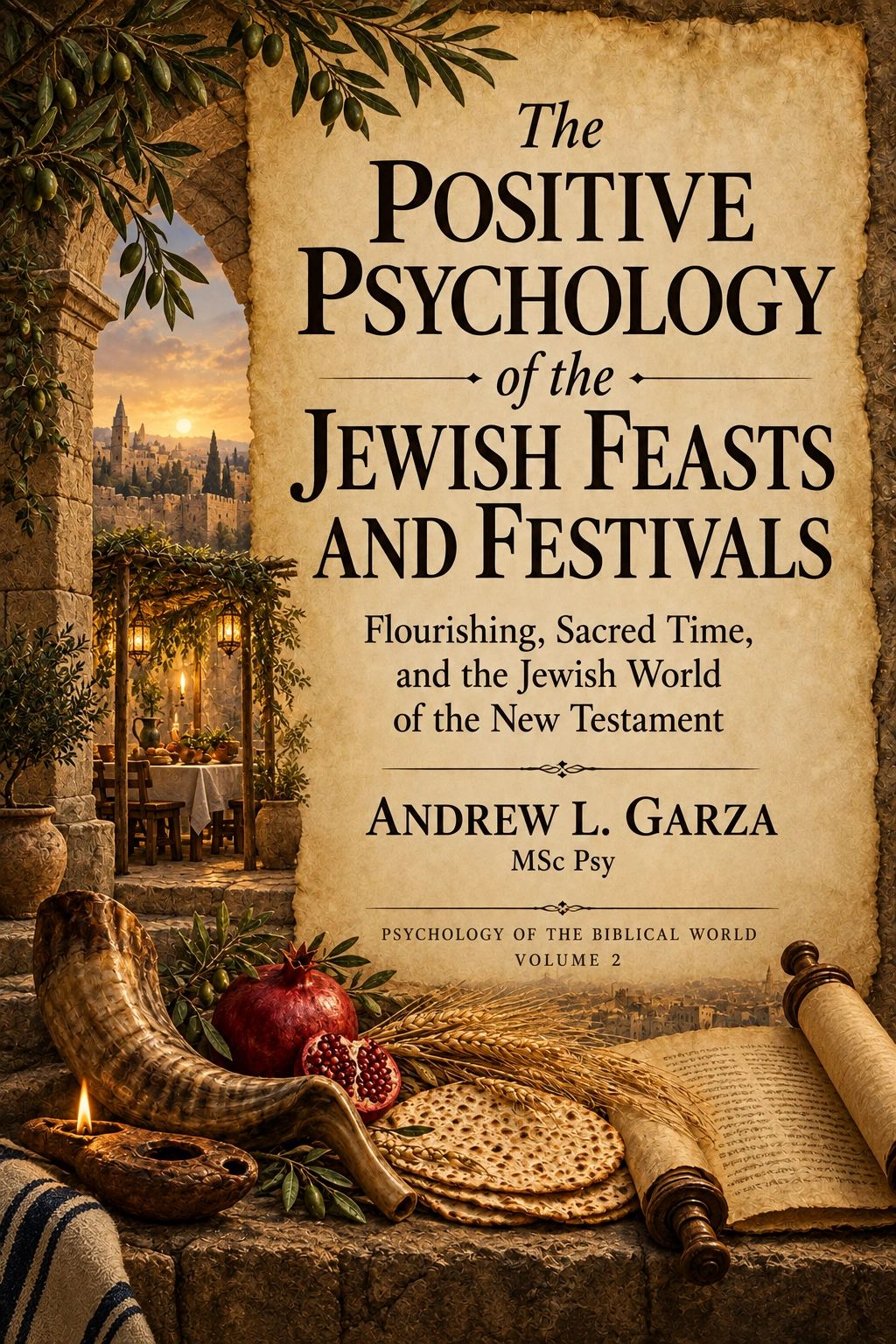
The Positive Psychology of the Jewish Feasts and Festivals: Flourishing, Sacred Time, and the Jewish World of the New Testament
The Positive Psychology of the Jewish Feasts and Festivals explores the biblical festivals not simply as dates on a religious calendar, but as recurring structures of memory, gratitude, repentance, hope, resilience, joy, belonging, and renewal.
Drawing on biblical studies, Jewish sources, Second Temple history, rabbinic literature, and positive psychology, Andrew L. Garza examines Passover, Unleavened Bread, Firstfruits, Counting the Omer, Shavuot, Yom Teruah, Yom Kippur, Sukkot, Shemini Atzeret, Simchat Torah, Hanukkah, Purim, and Tisha B’Av. Each observance is placed in its historical and cultural setting before considering its possible psychological significance.
The book pays special attention to the Jewish calendar, pilgrimage, communal meals, fasting, preparation, hospitality, ritual, sacred memory, and the Jewish world of the New Testament. New Testament passages are examined within the field of experience of first-century Judaism, helping readers recognize festival language and imagery that can easily be missed when they read the texts apart from their Jewish setting.
The book also applies insights from positive psychology, including gratitude, savoring, meaning, resilience, social connection, character strengths, and the broaden-and-build theory of positive emotions. These modern concepts are used as analytical tools rather than projected backward as explanations of ancient religious intent.
Throughout the study, Garza applies a strong critical-thinking approach, distinguishing direct evidence from probable reconstruction, interpretation, and hypothesis. Readers are encouraged to move beyond merely possessing information toward understanding how evidence, assumptions, concepts, and interpretation shape what they believe they know.
Written for readers interested in biblical studies, Judaism, early Christianity, psychology, and the historical world of Jesus, this volume offers an interdisciplinary examination of how sacred time can organize human attention, strengthen communal identity, preserve memory, and contribute to flourishing.
The Positive Psychology of the Jewish Feasts and Festivals is Volume 2 in the Psychology of the Biblical World series.