
Old Testament Survey
A Historical and Chronological Survey of the Old Testament guides readers through the Hebrew Bible as a unified historical narrative rather than as a disconnected collection of books. Drawing upon Dr. Roy B. Blizzard’s expertise in Hebrew, biblical history, archaeology, and the Jewish background of Scripture, the book follows Israel’s story from creation and the patriarchs through the Exodus, conquest, monarchy, exile, restoration, and intertestamental period.
Along the way, Dr. Blizzard examines the formation and transmission of the biblical text, the relationship between faith and scientific inquiry, important Hebrew words and concepts, archaeological discoveries, the rise and fall of Israel’s kingdoms, and the historical settings of the prophets and wisdom literature. His engaging lecture style challenges inherited assumptions and encourages readers to interpret Scripture within its original linguistic, cultural, geographical, and historical setting.
Accessible to serious students and general readers alike, this comprehensive survey provides a strong foundation for understanding the Old Testament and its essential relationship to the New Testament and the Jewish world of Jesus.
New Testament Survey
New Testament Survey presents Dr. Roy B. Blizzard’s classroom lectures in a clear, accessible study of the historical, cultural, political, linguistic, and religious world of the New Testament. Beginning with the centuries between Malachi and the birth of Jesus, the book traces the rise of the Persian, Greek, Maccabean, Herodian, and Roman worlds that shaped first-century Judaism.
Special attention is given to Jesus as a Jewish rabbi, the Hebraic thought and language underlying the Gospels, the Kingdom of God, the Gospel of Matthew, the Gospel of John, Acts, Paul’s letters, and Revelation. Throughout the book, Dr. Blizzard challenges readers to move beyond later assumptions and interpret the New Testament within the Jewish world from which it emerged.
Carefully transcribed and edited from live lectures, this volume preserves Dr. Blizzard’s engaging teaching style while adding helpful historical background, maps, illustrations, and explanatory notes. It is an ideal resource for pastors, teachers, students, and readers seeking a deeper understanding of Jesus, the early believers, and the Jewish foundations of the Christian faith.
Foundations for Biblical Study
Foundations for Biblical Study brings the classroom teaching of noted Hebrew scholar, archaeologist, and biblical educator Dr. Roy B. Blizzard to a new generation of readers. Carefully transcribed from his live lectures, this volume preserves his engaging conversational style while presenting a serious method for understanding Scripture within its original linguistic, historical, and cultural setting.
Dr. Blizzard explores how the Bible was formed and transmitted, the meaning of inspiration, the importance of Hebrew words and idioms, the historical development of biblical revelation, and the need to interpret each passage according to its original audience. He also examines the Gospel of the Kingdom, the Jewish roots of the earliest Jesus movement, and the gradual separation of Christianity from its Hebraic foundations.
Readers are invited to move beyond inherited assumptions and rediscover Jesus as a first-century Jewish rabbi whose teachings emerged from the world of Israel, Torah, Temple, synagogue, covenant, and prophecy. Designed for pastors, teachers, students, and thoughtful readers, this book offers essential tools for reading the Bible with greater clarity, accuracy, and depth.
Beginnings in Biblical Study
Beginnings in Biblical Study brings together a series of seminar teachings by Dr. Roy B. Blizzard that explore the biblical story from its Hebrew and Jewish foundations. Beginning with the Shema and the nature of God, Dr. Blizzard examines Hebrew understandings of humanity, the development of ideas about angels and evil, the patriarchs, Exodus, Israel’s history, the Babylonian exile, the Diaspora, and the rise of the synagogue. The study then moves into the world of Jesus and the earliest believers, examining the Kingdom of God, salvation, worship, leadership, and the organization of the first-century community of God.
Throughout the book, Hebrew words, archaeology, Jewish history, rabbinic concepts, and the cultural setting of Scripture are used to help readers recover meanings that can easily be obscured when the Bible is approached primarily through later Western Christian categories. Dr. Blizzard’s emphasis is not simply on accumulating biblical information, but on learning to think about Scripture within the historical and linguistic world in which it originated.
This book differs from Foundations For Study. Although the two books complement one another and share Dr. Blizzard’s commitment to restoring the Hebrew and Jewish background of the Bible, they are drawn from different seminar material and have different emphases.
Foundations for Biblical Study is more directly concerned with how to study and interpret the Bible. It introduces subjects such as how the Bible developed, why Scripture is distinctive, the historical world before Moses, Hebrew patterns of thought, the differences between Jerusalem and the Greco-Roman world, the Gospel of the Kingdom, and the importance of recovering the Jewish roots of Jesus and the New Testament.
Beginnings in Biblical Study goes further into the historical and theological content itself. It begins with God and humanity, follows the development of Israel from Abraham through exile and Diaspora, and culminates in a detailed examination of how Jesus understood the Kingdom, what it means to be “saved,” and how the earliest community of believers worshiped, organized itself, cared for its members, and functioned as a living community.
In that sense, Foundations for Biblical Study provides many of the tools for approaching Scripture, while Beginnings in Biblical Study demonstrates those tools at work across the biblical story and the world of the earliest believers. The books may be read independently, but together they provide a broader introduction to Dr. Blizzard’s approach to understanding the Bible within its original Hebrew, Jewish, historical, and cultural setting.
Jesus the Rabbi
Jesus the Rabbi: And His Rabbinic Methods of Teaching invites readers to encounter Jesus within the Jewish world of the first century. Drawing from the teachings of Dr. Roy B. Blizzard, this book explains how Hebrew language, Jewish education, rabbinic interpretation, the Mishnah, oral tradition, and ancient customs illuminate the words and actions of Jesus.
Readers will explore Jesus as an observant Jew and itinerant rabbi, the meaning of discipleship, the relationship between written and oral Torah, the distinction between Halakah and Haggadah, and the Jewish background of such important biblical concepts as the Kingdom of God, righteousness, repentance, ritual immersion, and loving-kindness. The book also examines the historical separation of the early Jesus movement from Judaism and shows how recovering the original cultural setting can clarify many misunderstood passages.
Accessible, engaging, and grounded in biblical history, Jesus the Rabbi will help students, pastors, teachers, and thoughtful readers move beyond inherited assumptions and rediscover the Gospels through the language, customs, and teaching methods of Jesus’ own world.
The Blood Covenant-Tithing-Praise
The Blood Covenant brings together three interconnected studies by Dr. Roy B. Blizzard that recover the Hebraic foundations of biblical faith. Beginning with the scriptural meaning of blood, sacrifice, atonement, and covenant, Blizzard traces these themes from Genesis through Passover, ritual immersion, the death of Jesus, baptism, and the Lord’s Supper.
The book then examines tithing, giving, and prosperity, challenging common assumptions about compulsory tithing and material wealth. It presents biblical giving as faithful stewardship and tzedakah—righteous generosity directed toward those in need—and defines true prosperity as wisdom, purpose, security, wholeness, and shalom.
The final study, Let Judah Go Up First, explores prayer, praise, worship, confession, forgiveness, gratitude, silence, and communion with God through the language and thought of the Hebrew Scriptures.
Accessible and thought-provoking, this collection invites readers to move beyond inherited traditions and rediscover the historical, linguistic, and spiritual context that gives the biblical text greater clarity, unity, and depth.
Who is Jesus Anyway?
Who Is Jesus Anyway? The Faith of Jesus invites readers to rediscover Jesus within the Jewish world in which He lived and taught. Drawing from the lectures of renowned Hebrew scholar and biblical archaeologist Dr. Roy B. Blizzard, this book explores the language, customs, Scriptures, and rabbinic teaching methods that shaped Jesus and His earliest followers.
Through careful examination of Hebrew concepts, biblical passages, and first-century Jewish life, Dr. Blizzard brings fresh clarity to the Kingdom of God, salvation, faith, healing, redemption, and the identity of Jesus as the Messiah. Challenging interpretations that have become separated from their historical foundations, this engaging study helps readers move beyond inherited assumptions and encounter the words of Jesus with greater depth, coherence, and understanding.
Science and the Bible
Science and the Bible: What Is Man That Thou Art Mindful of Him presents Dr. Roy B. Blizzard’s wide-ranging exploration of creation, human origins, morality, and the nature of mankind through the combined lenses of Hebrew Scripture, archaeology, anthropology, geology, and critical inquiry.
Rather than treating science and the Bible as enemies, Dr. Blizzard argues that many apparent conflicts arise from misunderstandings of biblical Hebrew, ancient culture, chronology, and the purpose of the Genesis account. Examining the creative “days,” geological eras, competing theories of origins, early humanity, monotheism, evil, free will, and the image of God, he challenges readers to reconsider familiar assumptions from both religious and scientific traditions.
Preserving the accessible style of Dr. Blizzard’s original classroom lectures, this volume invites thoughtful readers to move beyond simplistic debates and investigate the deeper questions: What does it mean to be human? When did humanity become morally responsible? And what role does mankind occupy within God’s creative purpose?
Understanding the Difficult Words of Jesus
Understanding the Difficult Words of Jesus, by David Bivin and Dr. Roy B. Blizzard, explores the Hebrew language, Jewish culture, and first-century background behind the teachings of Jesus. The authors show how many difficult or misunderstood Gospel passages become clearer when examined within the Hebrew and Jewish world in which Jesus lived and taught.
Mishnah and the Words of Jesus
The Mishnah and the Words of Jesus explores how early Jewish teachings preserved in the Mishnah can illuminate the language, ideas, and teaching methods found in the Gospels. The Mishnah is an early collection of Jewish oral teachings and legal traditions, compiled around A.D. 200. Dr. Roy B. Blizzard uses these parallels to help readers better understand Jesus within the Jewish religious and cultural world of the first century.
Tithing, Giving, and Prosperity
In this 25-page article, Dr. Roy B. Blizzard explains the ancient origins of tithing, giving, and prosperity from the historical and biblical perspective. He brings to light the laws and customs of tithing throughout history – through to present day.
Dr. Blizzard clears up many misperceptions: that the acquisition of material possessions equals prosperity, that one must give in order to receive, that tithing is a requirement of modern day Christianity.
His study reveals that tithing was strictly a Jewish practice; its basic purpose was as an act of charity (tzedakah) to support the poor and those in need; it was not practiced outside the land of Israel; after the destruction of the Temple, the practice of tithing ceased in Judaism, although acts of charity continued as a replacement for the sacrifices of the Temple, and more.
Citing multiple scholarly works in Hebrew, Greek, and English, Dr. Blizzard builds the case for attaining biblical prosperity – free of coercion.
Prosperity means to be safe, to be secure, to be at ease or rest; it means to have peace – to have shalom – to be whole, to be complete – a wholeness and completeness through God who lives and dwells within. Once one understands what real prosperity is, it becomes of much more value than the mere accumulation of material possessions. Real prosperity is Life! Life with God and in God.
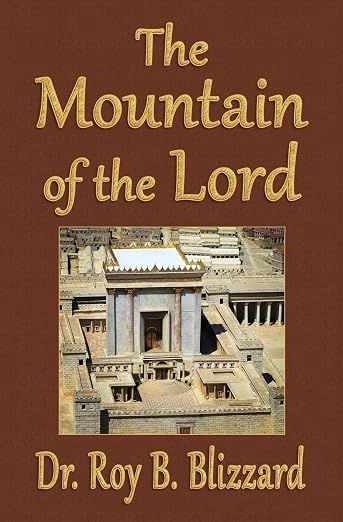
The Mountain of the Lord
In this 48-page book, Dr. Roy B. Blizzard presents a historical view of the Mountain of God (the Temple Mount), the individuals associated with it, the structures that occupied the site, as well as the present condition and future implications. Perhaps no other spot on earth is considered so sacred or is surrounded by so much tradition and/or legend as Mount Moriah – the Holy Mountain, the Mountain of God, the “Mountain of the Lord.”
Dr. Blizzard describes the First and Second Temples in detail – their location, construction, furnishings, and inner courts – citing biblical and historical sources throughout.
A vivid picture emerges as he explains the political, economic, and social forces that led to the rise and fall of the Temples, their destruction, and the building of the Dome of the Rock and El-Aqsa Mosque.
In conclusion, Dr. Blizzard considers these important questions: Does anything remain of the Temple? What happened after the destruction of the Temple? Where was the Holy of Holies really located?
The Mountain of the Lord paints an intriguing picture of the intertwined history of Israel, Jerusalem, and the many religions that have battled for the Temple Mount.